Blog
Fire Across Civilizations — The Most Sacred Element in Human Mythology

Fire mythology is perhaps the most universal of all the elemental traditions, the one thread that connects every human civilization that has ever existed, from the earliest hunter-gatherers who gathered around the first controlled flame to the priests and philosophers of the great ancient empires who made fire the center of their most sacred rituals. No other element has been so consistently deified, so universally feared and revered, so fundamentally understood as a threshold between the human and the divine. Every civilization that has ever built a hearth, lit a torch, or watched a volcano erupt has recognized in fire something that exceeds its physical nature: not just heat and light, but transformation, power, and the force that makes civilization itself possible.
In ancient Rome, the sacred flame of Vesta burned continuously in the Temple of Vesta at the center of the Forum, tended by the Vestal Virgins, its extinction considered a catastrophe for the entire city. In Persia, the Zoroastrian tradition placed fire at the center of its theology: Ahura Mazda, the supreme deity, was associated with light and fire, and the sacred flames of the Atash Bahram temples have burned continuously for centuries, some for over a thousand years. In Japan, the fire deity Kagu-tsuchi was so powerful that his birth killed his mother Izanami, initiating death itself into the world, a being whose very existence was too fierce for the order of things to contain.
The convergence across traditions is too consistent to be coincidence. Every civilization independently arrived at the same understanding: that fire is not merely a tool but a presence, not merely useful but sacred, not merely dangerous but alive. It is the element that most directly mirrors the nature of the divine, visible yet untouchable, life-giving yet lethal, ancient yet always new. What burns is never quite the same twice.
Agny Earrings — The Sacred Flame of the Vedas
In the Vedic tradition of ancient India, fire was not merely associated with a deity, it was the deity. Agni is the flame that burns in the hearth, in the sun, in the lightning bolt, and at the center of every sacred ceremony. In the Rigveda, the oldest of the Hindu scriptures, Agni is invoked more than any other god, the first word of the first hymn is his name. He is the messenger between worlds: the sacrificial fire carries the offerings of the human into the realm of the divine, transforming material substance into communication across the threshold of existence. To place something in Agni’s fire is not to destroy it but to transmit it.
Agni does not merely represent transformation, he is transformation. His body is the process itself: the consuming, the illuminating, the converting of one state of being into another. This is why fire sits at the center of the most important ceremonies in Hindu tradition: the wedding fire that witnesses vows, the funeral fire that releases the soul, the dawn fire that greets the returning sun. Each is Agni in a different aspect, performing a different mediation between the human and the sacred. The Agny earrings by Friszman MD carry this transformative energy in 18k gold, a piece that does not sit still, whose form suggests the constant motion of flame finding its shape in the moment of burning.
Pelee Ring — The Goddess Who Is the Land
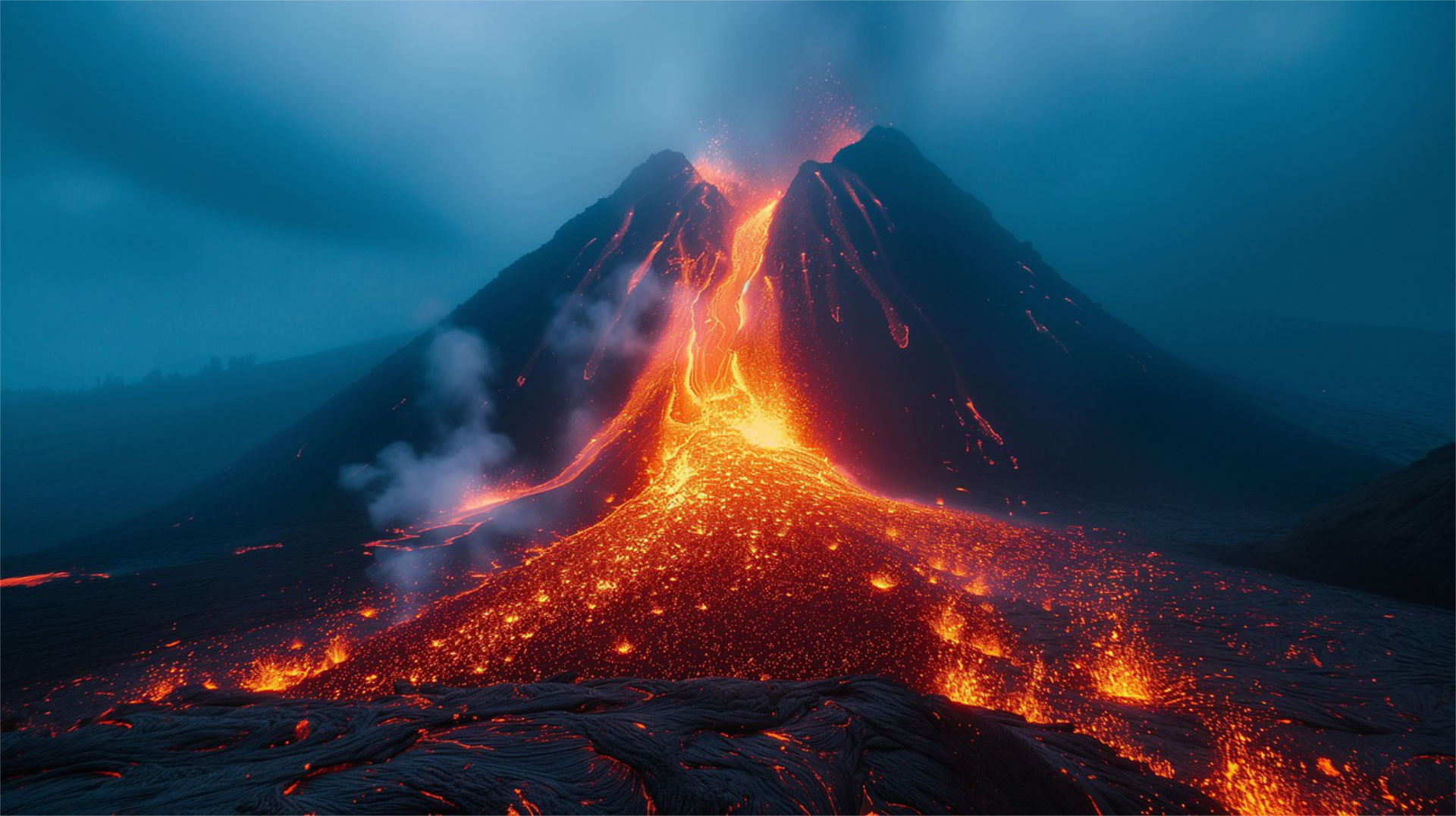
On the other side of the world, in the volcanic archipelago of Hawai’i, a completely different civilization arrived at a remarkably similar understanding. Pele, the Hawaiian goddess of fire and creation, is not a deity who controls fire from a distance. She is fire. She is the lava that flows from Kilauea’s caldera into the sea, creating new land at the point where the most ancient element meets the ocean. When the volcano speaks, Pele is speaking. When the lava reaches the sea and new land forms, Pele is extending her body into the world. Her presence is not metaphorical — it is geological.
The myth of Pele’s journey from Tahiti to Hawai’i, pursued across the ocean by her older sister Namakaokahai, the sea goddess, is a story about the kind of force that cannot be destroyed but only relocated. Everywhere Pele stopped, she tried to establish a home; everywhere her sister flooded her out. Until she reached the Big Island, where the volcanoes were deep enough and hot enough that even the sea could not extinguish her. The Pelee ring by Friszman MD translates that elemental permanence into 18k gold, a sculptural band that carries the memory of lava finding its final form: unstoppable, elemental, alive.
Enceladus Ring — Fire Beneath the Earth
In Greek mythology, fire lives not only above the earth but beneath it. Enceladus was one of the great Giants who fought against the gods in the Gigantomachy, the primordial battle for control of the cosmos. When the Olympians triumphed, Athena buried Enceladus beneath the island of Sicily, and the Greeks believed that his breathing was the source of Mount Etna’s volcanic fire. The giant was not destroyed. He was contained, his heat, his power, his rage compressed into the earth itself, erupting periodically as a reminder that what is buried does not disappear.
The name Enceladus was later given to one of Saturn’s moons, a world of ice with active geysers erupting from its southern pole, a frozen body alive with interior heat. Two stories, one name: the giant beneath the mountain and the moon that burns beneath its ice. Fire contained. Fire enduring. The Enceladus ring by Friszman MD captures that eternal tension in 18k gold, a bold sculptural band that holds within it the memory of a force that cannot be extinguished, only shaped. Ice and fire. Strength and grace. The surface and what burns beneath it.
Fire mythology teaches what the other elements only suggest: that transformation is not destruction but passage, a change of state that preserves the essential while releasing the incidental. The gold that flows into form, the heat that transforms raw material into something permanent and beautiful, every piece of jewelry begins in fire and carries that origin in its final form. To wear a piece shaped by fire’s mythology is to carry at the skin the oldest and most universal truth in human culture: that what endures is what has passed through the flame.